
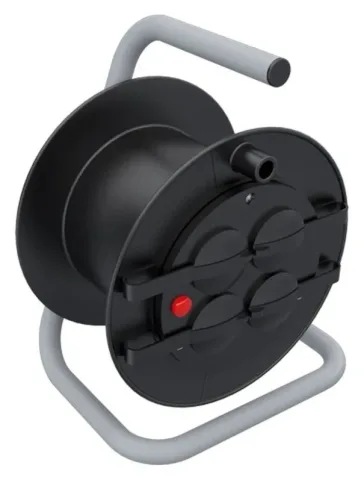
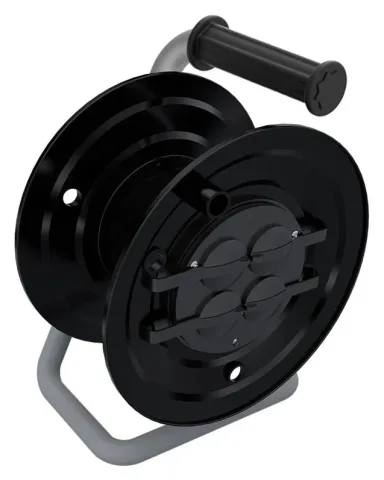

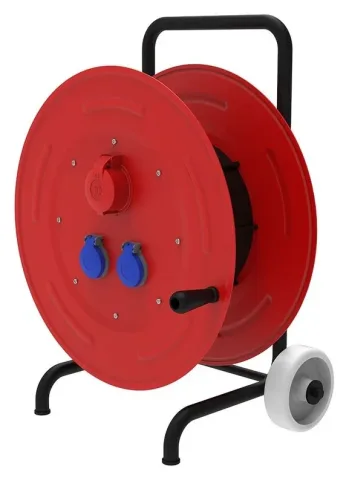
Bemis cable reel drums
The table below compares the drums of Bemis cable reels. Cable capacity is given for the cable in the standard cable column; with a thicker cable, the length that fits is shorter.
| Drum | Material | Cable capacity | Standard cable | IP class |
|---|---|---|---|---|
| BM7 | Plastic (polypropylene) | 15 m | 3 × 1.5 mm² | IP44 |
| BM8 | Plastic (polypropylene) | 25 m | 3 × 1.5 mm² | IP44, IP54 |
| BM9 | Plastic (polypropylene) | 50 m | 3 × 1.5 mm² | IP44 |
| BM1 | Metal (0.7 mm sheet steel) | 25 m | 3 × 1.5 mm² | IP20, IP44 |
| BM2 | Metal (0.8 mm sheet steel) | 50 m | 3 × 1.5 mm² | IP20, IP44 |
| BM3 | Metal (0.8 mm sheet steel) | 50 m | 3 × 2.5 mm² | IP44, IP54 |
| BM4 | Metal (1 mm sheet steel) | 40 m | 5 × 2.5 mm² | IP44, IP67 |
| BM5 | Metal (1 mm sheet steel) | 100 m | 5 × 2.5 mm² | IP44, IP67 |
| BM6 | Metal with trolley (1 mm sheet steel) | 100 m | 5 × 2.5 mm² | IP44, IP67 |
1. Determine the cable length
First measure the longest distance between the socket and the working point and add an allowance for the cable running along the floor. Choosing a reel that is much longer than necessary is not an advantage: the longer the cable, the greater the voltage drop, and the unused part stays wound on the drum. 15–25 m is common for home and workshop jobs and 40–50 m for construction-site and field work; the BM6 drum with 100 m capacity is supplied on a wheeled trolley because of its weight.
2. Choose the cross-section and number of cores
3-core cable is used for single-phase (230 V) loads and 5-core cable for three-phase (400 V) loads. The BM1, BM2, BM3, BM7, BM8 and BM9 drums are designed for 3-core cable, and the BM4, BM5 and BM6 drums for 5-core cable.
The cross-section is chosen according to the current drawn and the cable length: 1.5 mm² or 2.5 mm² for loads up to 16 A, and thicker cable for long runs and higher currents. The larger the cross-section, the shorter the cable that fits on the same drum; for example, the BM4 drum takes 40 m of 5 × 2.5 mm² cable but 25 m of 5 × 4 mm². For details on choosing the cross-section, see the cable cross-section guide.
3. Choose the socket type
The sockets on the reel must match the plugs of the equipment to be connected:
- 3-core drums (BM1, BM2, BM3, BM7, BM8, BM9): fitted with 2 to 4 earthed 16 A 230 V sockets. Versions with French-type sockets are also available.
- 5-core drums (BM4, BM5, BM6): 16 A 230 V sockets are combined on the same drum with 16 A, 32 A and, on some models, 63 A CEE sockets (3P, 4P or 5P). One reel can therefore supply both hand tools and three-phase machines.
- Drums without sockets: if you will fit the cable and the connection yourself, every drum is available without sockets.
The socket configuration of each model is listed in the table on the product page, with quantity, current, voltage and number of poles. For the meaning of the number of poles on CEE sockets, see the guide on pole count and clock position.
4. Choose the IP protection class
IP20 reels are intended only for indoor, dry locations. Outdoors, on construction sites and wherever water may splash, at least IP44 should be chosen; IP54 adds protection against dust. IP67 drums are used where equipment is washed down or may be temporarily under water. The difference between the classes is explained in the IP44 and IP67 guide.
5. Plastic or metal?
Plastic cable reels have a polypropylene drum; they are light, easy to carry and suited to home, garden and workshop use. Metal cable reels have a sheet-steel drum; they are more resistant to impact and heavy use and are therefore preferred on construction sites and in industry. For jobs that require three-phase cable and CEE sockets, the choice is the metal drums (BM4, BM5, BM6).
Thermal cut-out and safe use
Wound cable cannot dissipate heat, so the cable must be fully unwound when the reel is used at high current. On models with a thermal cut-out, the cut-out opens the circuit when the cable overheats, and the reel can be used again once it has cooled down. Before using the reel, check the cable for crushing, cuts or stripped insulation; do not work with a damaged cable.


 16 A
16 A  63 A
63 A  125 A
125 A  11 kW
11 kW  22 kW
22 kW  Type 2
  CCS2
CCS2